
We take our name, our mark, and our whole disposition from one object. The aquila was the eagle standard of a Roman legion: a small silver bird, wings spread, mounted on a pole and carried at the front of the column. There was exactly one to a legion, five thousand men to a single bird, and the legion was understood to be it. Lose the eagle and the legion had ended, whoever was still standing.
One legion, one eagle
It was not always so. The early legions marched behind five different animals, the eagle among them but also the wolf, the boar, the horse and the minotaur. Around 104 BC, in the middle of the reforms that made the professional Roman army, Gaius Marius swept the other four away and left the eagle alone. From then on the aquila was the legion's single identity, kept in a shrine in the middle of the camp with the pay chest beside it, because the safest place in a Roman fort was the one the soldiers guarded on their honour.
The man who carried it was the aquilifer, chosen for steadiness rather than swordsmanship and paid at twice the ordinary rate. He wore a lion or bear skin over his helmet, he stood beside the commander in the line, and he had one job that outranked every other: the bird does not go down.
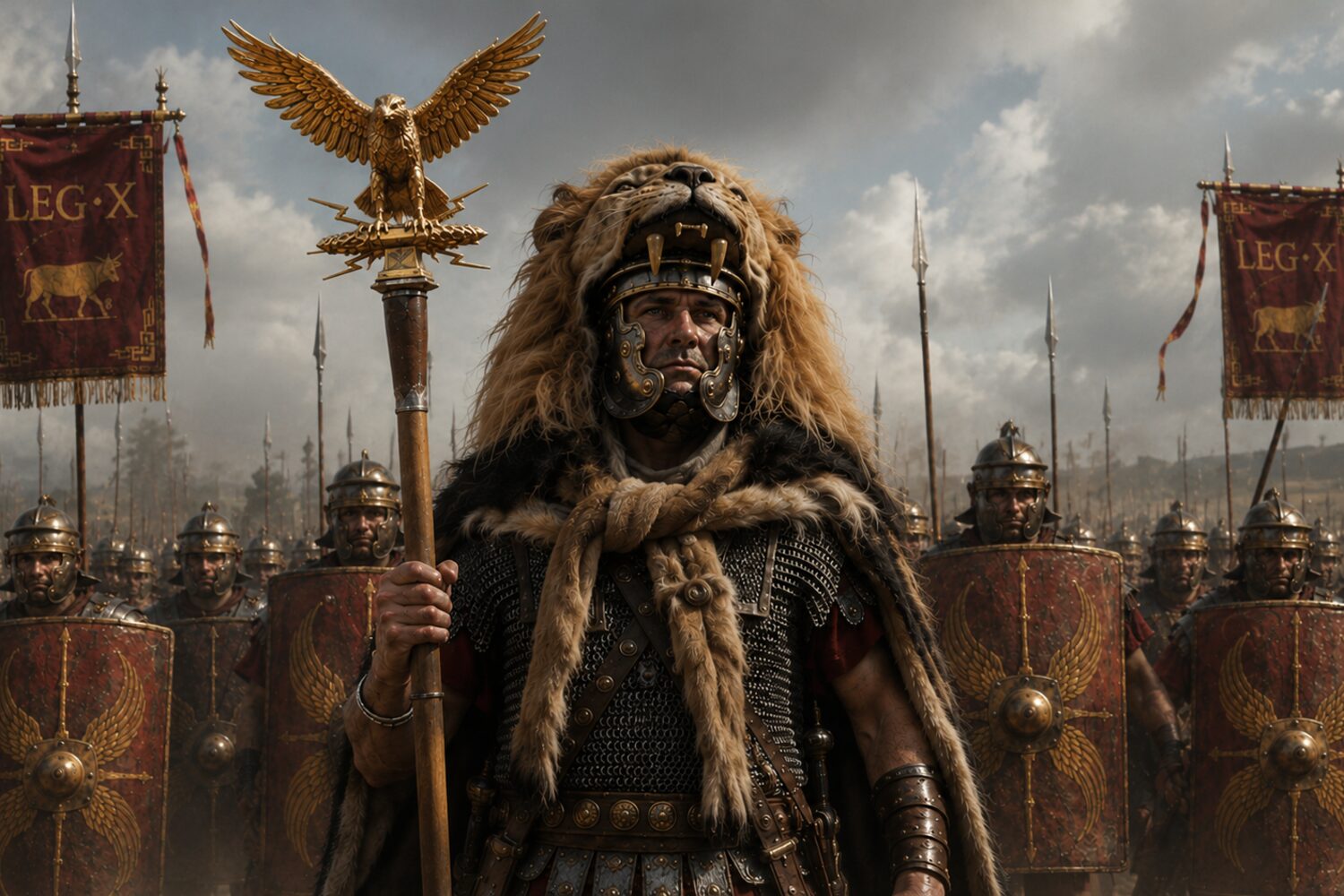
The Tenth goes into the sea first
Our legion is in the most famous of all the eagle stories. In 55 BC Caesar's ships reached the coast of Britain and stopped in deep water, and his men would not jump: unfamiliar shore, a shingle bank lined with painted infantry, and armour that does not float. It was the aquilifer of the Tenth who ended the argument by going over the side alone with the eagle in his hands, calling back that he at any rate intended to do his duty to the Republic and to his general. The legion came off the ships after him, because the alternative was to stand on deck and watch the eagle taken. Caesar tells the story himself in the fourth book of the Gallic War, and it is as good an account of how the thing worked as anyone has written since.
Rome always got them back
An eagle that went astray was never written off. Rome would spend decades and whole campaigns bringing one home, and treated the day it arrived as a national event rather than a piece of housekeeping.
Germanicus brought two back from beyond the Rhine, and the last of that set came home under Claudius. The eagles Crassus had left with the Parthians at Carrhae in 53 BC returned in 20 BC, and Augustus managed it by negotiation rather than by war, then put the moment on the coinage and on the breastplate of his own statue, which tells you exactly what it was worth to him. A recovered eagle counted for more in Rome than a province.
Why the eagle, and why us
The bird belonged to Jupiter, so a legion marched under the god's own creature, and there is no accident in that. It also happens to be the plainest possible statement of the Roman idea: one object, small enough to carry, that thousands of people agree to treat as more important than themselves. Empires are built out of agreements like that.
That is the emblem on your certificate. Not a coat of arms, not a badge of rank, but the standard a legion formed up behind, drawn in the old manner and set at the head of your name, in the way the Tenth would have recognised.