
Every army has a rank where the real work happens, and in Rome it was this one. Above the centurion sat tribunes and a legate, who were politicians serving a turn in uniform. Below him sat the men. The centurion was the join, and he was the only man in that structure who had usually come up from the bottom.
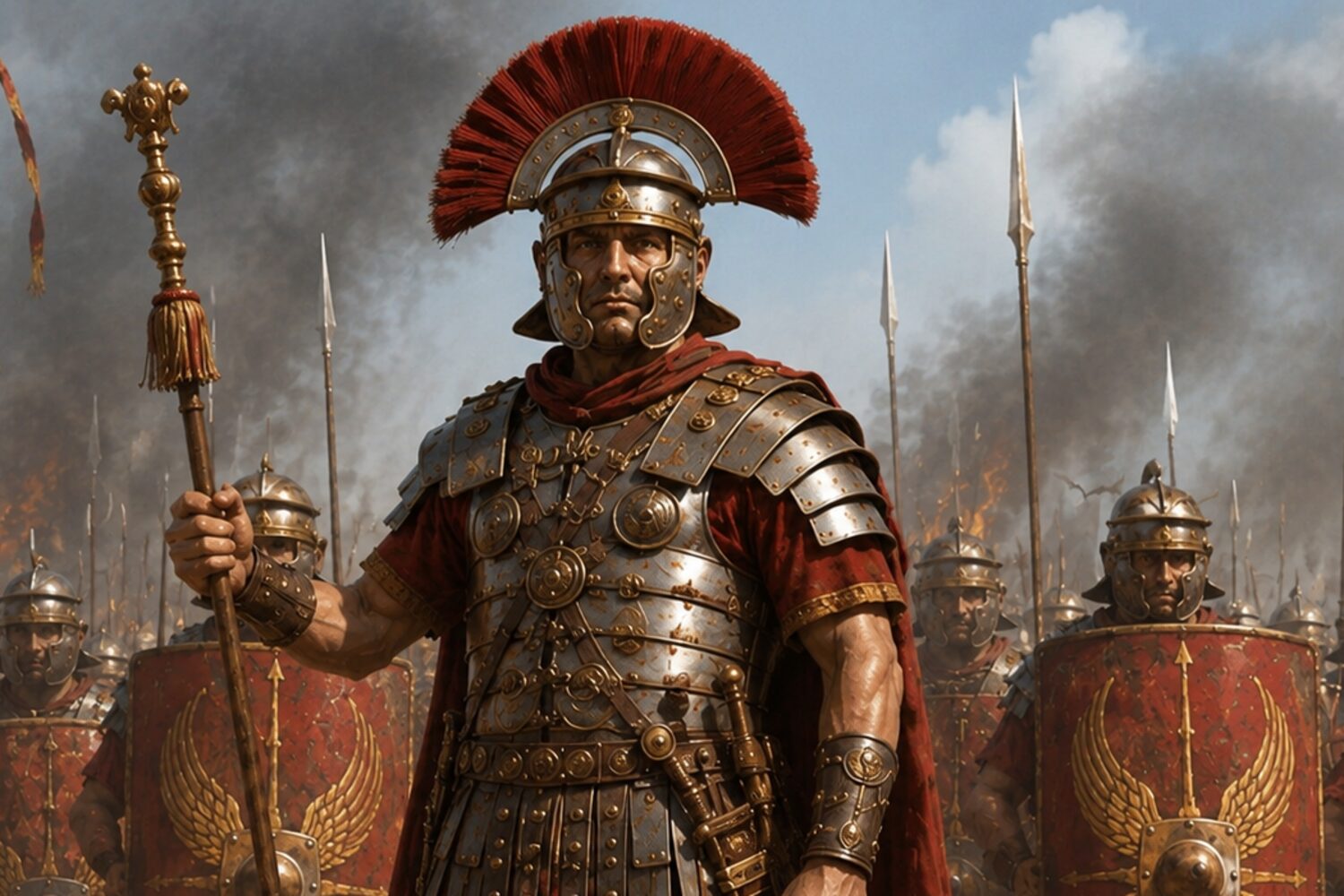
Eighty men called a hundred
A centuria should by its name hold a hundred. It held eighty. Six centuries made a cohort and ten cohorts made a legion, so a legion carried sixty centurions, and each of them owned the training, the discipline, the marching order and the fighting line of eighty specific men whose names he knew.
The unit had not shrunk by accident or neglect. Eighty is ten tent parties of eight, and the tent party was the atom the whole army was built out of: one leather tent, one mule, one millstone, one cooking pot, and everything earned together. A century was ten of those. The round hundred was the older word and nobody bothered to change it.
The vine staff
His badge of office was the vitis, a length of vine stock about a metre long, carried in the hand and recognised instantly by every man in the legion. No plume, no crest, no paperwork: a centurion was the man holding the vine staff, and that was the entire announcement.
It is one of the better pieces of design Rome produced. A single object, cheap to make, impossible to mistake, and the authority went with whoever held it.
Promoted out of the ranks
What made the centurionate remarkable in a society as stratified as Rome's is that a man could reach it from nothing. The senior commands were closed: you were born into them or you were not. The centurionate was not. A legionary who was steady, literate enough, and did not die could be promoted into it, and the pay stepped up by something like fifteen times an ordinary soldier's.
At the top of the ladder stood the primus pilus, the first spear, senior centurion of the first century of the first cohort. He sat in the commander's council with the tribunes, and on discharge he had money and standing enough to enter the equestrian order. A farmer's son could, in one career, end up a knight. Not many did. The point is that the road existed at all, and every man in the line could see it.
Pullo and Vorenus
Caesar names very few individual soldiers in the Gallic War, which is what makes the fifth book worth reading. Two centurions in Quintus Cicero's besieged camp, Titus Pullo and Lucius Vorenus, had spent years competing for promotion and disliking each other publicly. During the siege Pullo taunted Vorenus for hanging back and charged the enemy line alone. He got himself surrounded and pinned. Vorenus went out after him, and when Vorenus in turn went down, Pullo got up and pulled him clear. They both walked back inside the rampart.
Caesar ends it by declining to say which of the two was the better man. It is the single most human paragraph in the book, and both of them were centurions, because that was the rank where a man had something to prove.
What it means on your certificate
A Centurion enrollment inscribes Centurio and your name into Legio X Equestris, in the old manner, sealed with the eagle. It carries the best job title the Roman army ever produced, and the reason it was the best. It is an honorific and a souvenir, and it confers no rank, no service and no entitlement. Our notice sets that out in full.